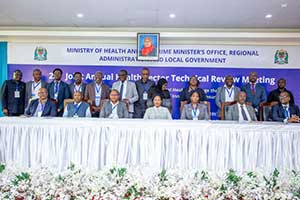
In order to assess the health sector's performance for 2025 and establish priorities for the 2026–2027 fiscal year, government officials, development partners, non-state actors and the business sector gathered at the 25th Joint Annual Health Sector Technical Review Meeting (JAHS–TRM) in Dodoma. "Accelerating achievement of Universal Health Coverage through Transformative Leadership, Accountability and Digital Innovation in Ensuring a Healthy Society" was the primary focus of the gathering. Prof. Tumaini Nagu, Deputy Permanent Secretary for Health at the Prime Minister's Office of Regional Administration and Local Government (PMORALG), was appointed its chairman.
In her speech, Prof. Nagu reiterated the government's commitment to increasing access to basic services by implementing Universal Health Insurance (UHI) nationwide. She highlighted the rapid digital transformation, improved local administration and infrastructure expansion, noting that 97.8% of public facilities had GoTHOMIS installed. Human Resources for Health (HRH) shortages, commodities shortages and the need to improve readiness for emerging diseases were among the main issues mentioned. In order to guarantee that policy aims are successfully carried out, she demanded increased coordination.
Dr. Alex Magesa, Acting Permanent Secretary of the Ministry of Health, highlighted the significance of evidence-based decision-making to promote accountability and quantifiable advancements. Gains in specialized services, better sector reporting, higher use of Primary Health Care (PHC) and lower maternal mortality were also highlighted by him. He did, however, highlight the ongoing lack of HRH, the rise in non-communicable diseases (NCDs) and the necessity of completely integrating digital systems to enhance productivity and data utilization.
The Development Partners Group for Health, led by Chairperson Ms. Melissa McNeil-Barret, reaffirmed their dedication to supporting government priorities, such as the implementation of UHI, the creation of the Health Sector Transformation Plan (HSTP 2026–2031) and bolstering domestic manufacturing of basic necessities. The significance of greater interoperability of digital health systems and coordinated multisectoral participation was underscored by development partners.
Dr. Anthony Mwendamaka, a representative of Non-State Actors in Health, recognized advancements in health information systems, medication accessibility and community-level accountability. They pointed out that service delivery is still hampered by HRH shortages at the PHC level, dispersed digital platforms and uneven funding for community health workers. They reiterated their dedication to UHI enrollment mobilization, community-based monitoring and behavior modification programs.
Representatives from the private sector and religious organizations, such as APHTA, BAKWATA and CSSC, as represented by Dr. Samwel Ogillo, praised the government for acknowledging their contribution to the provision of services. They noted that rising demand was associated with higher insurance coverage and emphasized the need for infrastructure and HRH investments to keep pace with industry expansion. They stated that they were prepared to support the HSTP's growth and urged the increase of specialized training and local production, particularly for vital cadres like anesthesia providers.
The Annual Health Sector Performance Profile, National Health Accounts, Public Expenditure Review, Mid-Term Review of the Health Basket Fund and Joint Field Visits Report were among the major sector reports that stakeholders examined for evidence. Rising NCD prevalence, HRH gaps, systemic fragmentation, diminishing external support and the requirement to improve sustainable domestic health spending were among the common concerns noted by the synthesis of these papers. In accordance with WHO's six healthcare system building blocks service delivery, infrastructure and quality of care, healthcare workforce, medications, medical devices and standardized technology, health funding and social security, and health information systems and governance participants created priority policy recommendations for FY 2026–2027 based on this assessment. In line with Vision 2050, they also determined which policy concerns should be prioritized for the upcoming five-year HSTP (2026–2031).
Shared accountability for industry performance was highlighted in the concluding thoughts. Timely incorporation within the UHI framework was demanded by the commercial sector. Development partners emphasized that in order to optimize efficiency and value for money, the Sector-Wide Approach (SWAp) must be strengthened. The Ministry of Health affirmed that the proposals would influence policy pledges and yearly action plans, noting that responsibility is crucial for preserving trust and guaranteeing successful implementation. Prof. Nagu reiterated the government's commitment to boosting budget allocations from local to national levels, enhancing information technology for better planning and bolstering governance at all levels. She urged all partners to help carry out the initiatives that have been decided upon.
At the Joint Annual Health Sector Policy Meeting, co-chaired by the Ministers of Health and PMORALG, the Policy Recommendations Submitted will be examined and approved as Policy Commitments for FY 2026/27. WHO, acting as the Secretariat to the Government and the Development Partners Group for Health, will keep providing technical assistance and coordination to guarantee efficient planning, alignment and implementation of the Joint Annual Health Sector Review process.

Expogroup is a full service exhibition organiser with over 30 years experience in International trade exhibitions. Our current portfolio includes 28 annual exhibitions from a diverse range of industries being held across the Middle East & Africa.
EXPOGROUP © 2026 | Privacy policy